| Fast Load Version |  S P E C I A L T
R A V E L R E P O R T S P E C I A L T
R A V E L R E P O R T |
| Secrets of Digital Photography Digital Rebel in China! 6 / 6 / 2004 |
| Fast Load Version | S P E C I A L T
R A V E L R E P O R T |
|
Jump All photos by
the author. |
Uncommon Value / Uncommonly Good Images Digital Rebel Page 1 of 4 Page 2 Page 3 Page 4 Canon makes cameras, lenses, scanners, printers, copy machines, FAX machines and equipment that manufactures integrated circuits and semiconductors. Handy that. It means they are in a prime position to fabricate the chips that run inside their products. No middle men. And for their line of advanced digital Single Lens Reflexes, it seems they have done just that. Most cameras have a CCD image chip. Canon has fabricated their own CMOS device and refined it to a higher degree than other CMOS manufacturers have achieved.
With images of 3072 x 2048 pixels in a 3:2 aspect frame printed at the photographic threshold of 180 pixels per inch on glossy paper, the numbers suggest that prints 17 inches wide (433mm) are a predictable reality and actual print making bears this out. 11 x 17 prints (full bleed tabloid size) are well within the performance envelope of this camera. Images here are scaled to Internet viewing size, but virtually all originals will sustain large blow-ups. Many images on these pages are larger than their display size, so if your browser can open them on a page by themselves, their larger image can be viewed immediately. For a lot more money they will sell you a dSLR body with an 11-megapixel full-frame sensor in it that makes similarly detailed prints covering around 24 inches wide, but the EOS 300D Digital Rebel (Called the Kiss Digital in Japan) brings most of this into your hands for a convenient $1000 including a basic 3:1 wide to tele zoom lens. The plastic body saved you money and produced a lightweight, rugged camera. It lacks the solid feel of a fully professional capital investment, but the images it produces offer no excuses. In China most of the Rebel's gatherings were saved at the largest image size at ISO speeds of 100 to 400. Under extreme conditions ISO 800 and 1600 were used. If you ever wondered what the basic process of digital image gathering is, Canon has a movie (RealVideo format) that explains the notion with computer graphics. The kit contained one EOS 300D silver body and three lenses: 18-55mm Kit Zoom Lens f/3.5-5.6. Sigma 28-200mm zoom f/3.5-56. Canon 50mm f/1.8 prime for low-light situations. In practice, the 50mm fast lens was rarely used, but the other two were used with nearly equal frequency.
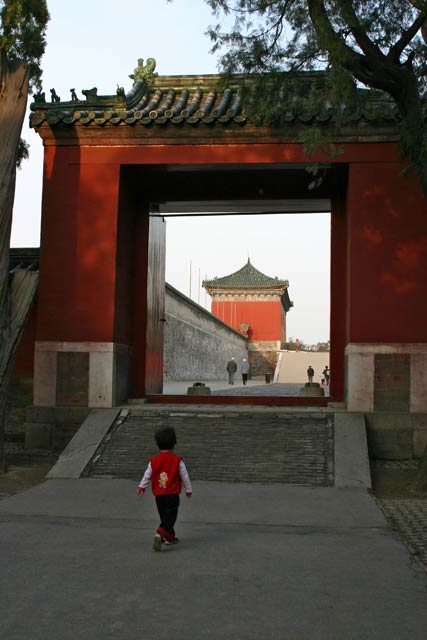
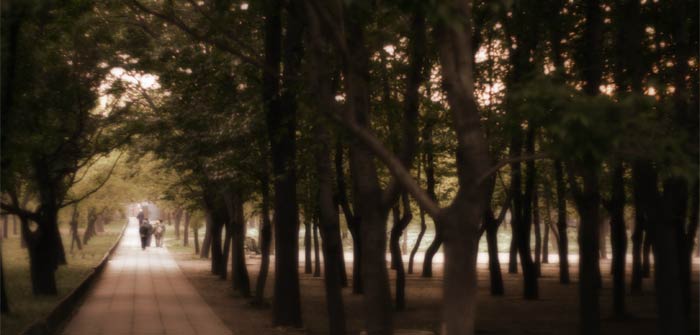 iNovaFX Photoshop Action iHalcyonWarm can turn images into memories. Beijing Tian Tan Park.
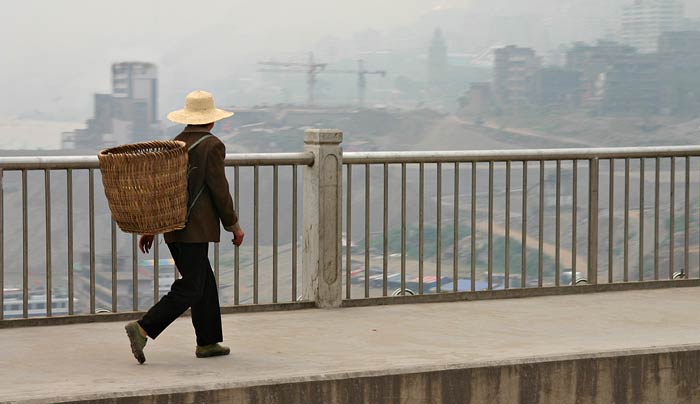 In all of China, everybody seemed fit.
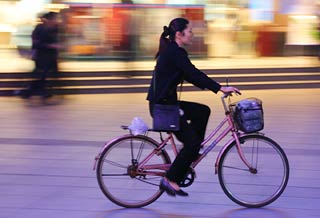 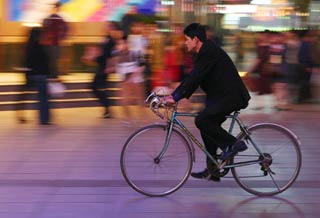 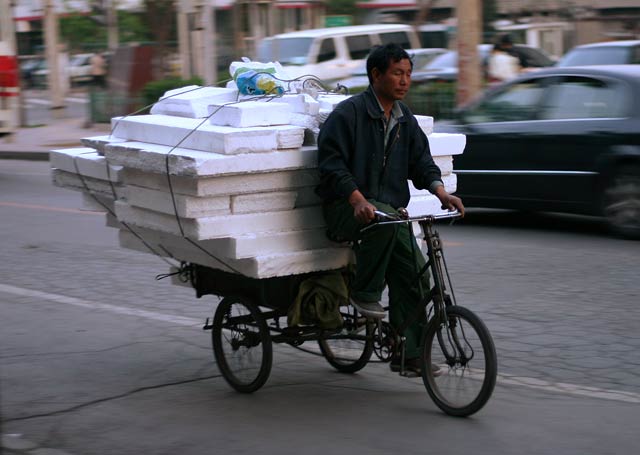 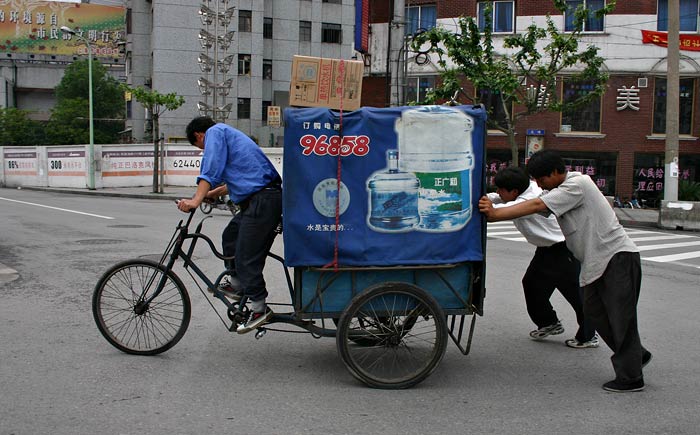 Flat cities like Beijing and Shanghai are popular with bicycle riders. And when real hauling is required, just add a third wheel.
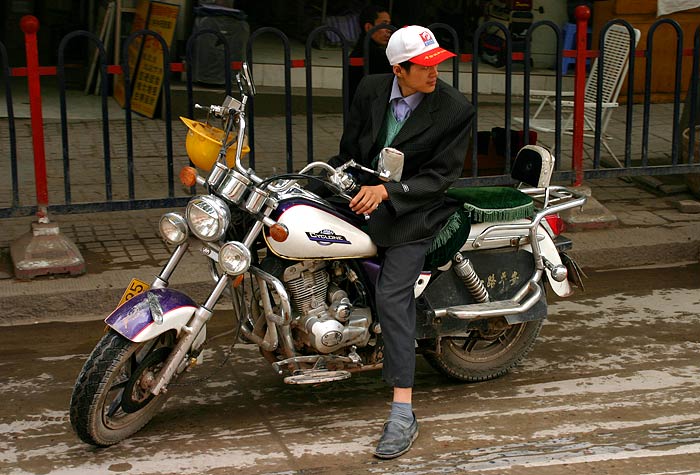 Better yet, get a motor under your seat and become a taxi.
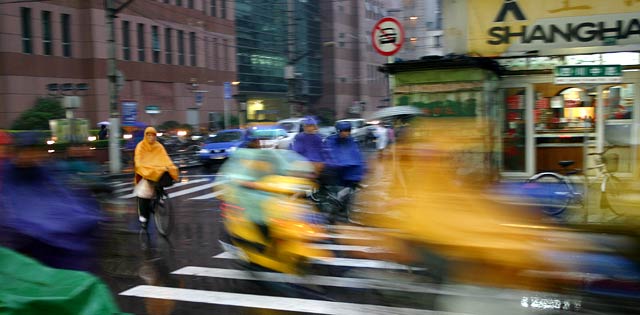 When the going gets wet, the wet get going.
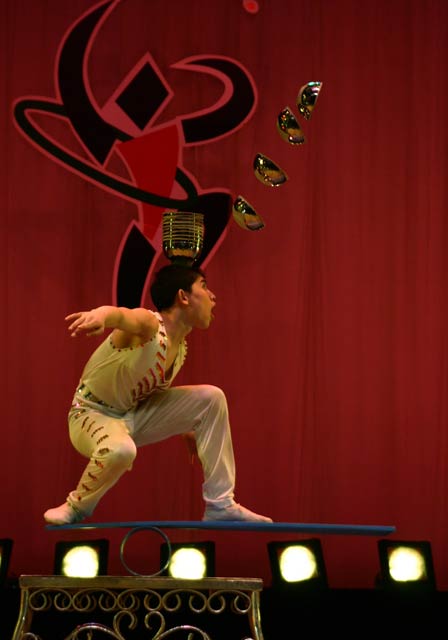  Young acrobats in Wan Zhou demonstrate that almost anything can look impossible with enough practice.
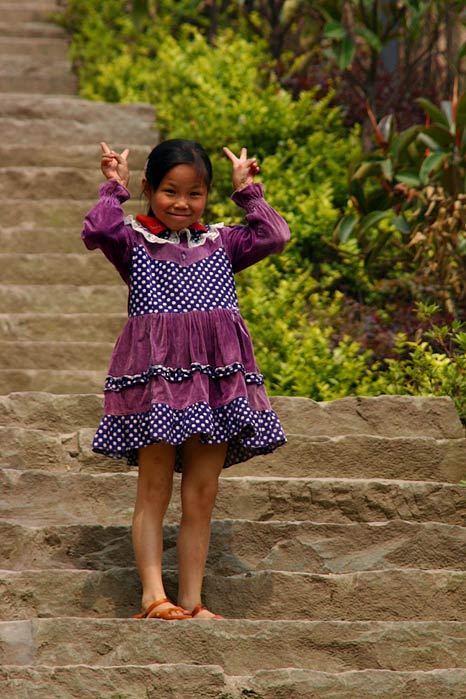  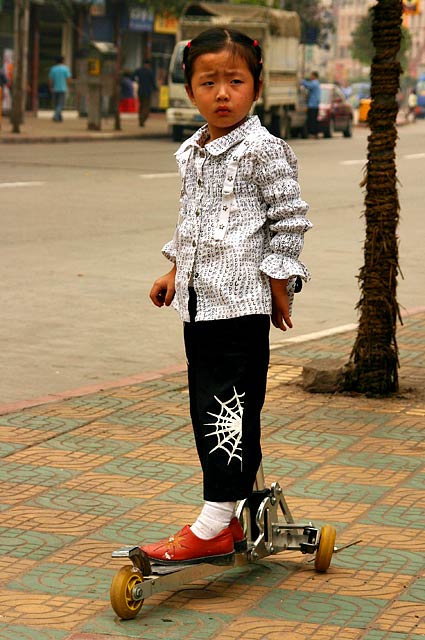 Ladies, start your engines.
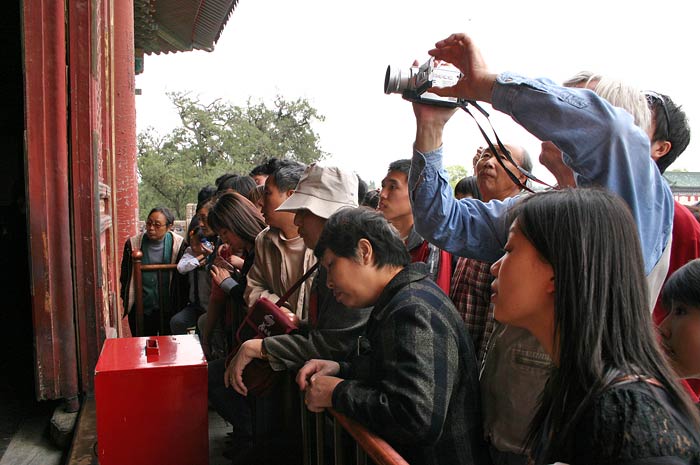 Whatever it is, it must be fascinating or, at minimum, inscrutable.
  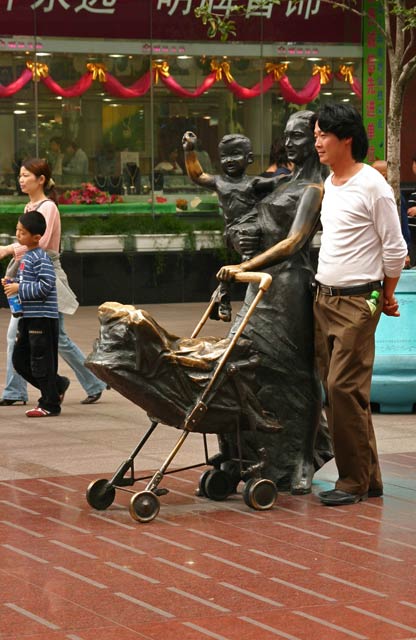 Shanghai: Infrastructure growing pains. Did Marco Polo design that pagoda? Meet my statuesque wife and kid...
 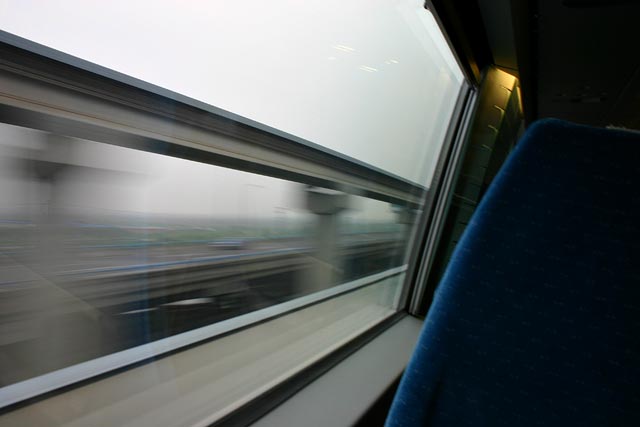  Magnetic levitation trains run to the Shanghai Airport at jet speed. Thank goodness for clarity in signage.
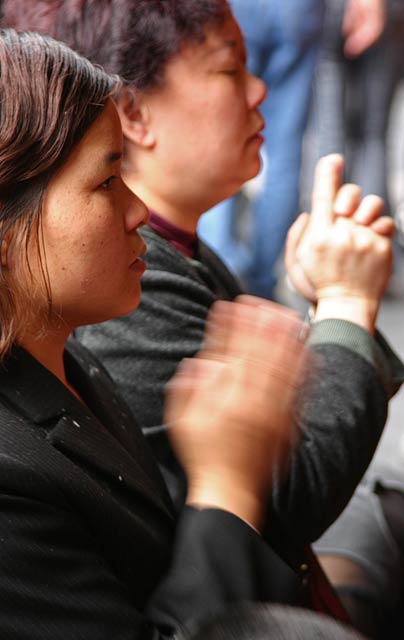   At a shrine: How locals look to tourists. / How tourists look to locals.
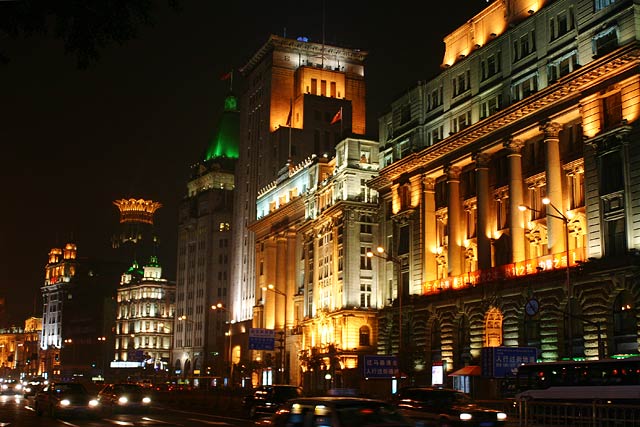  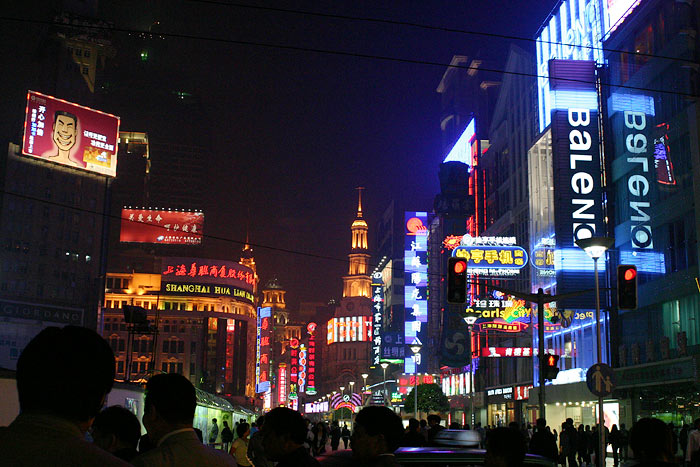 Shanghai nights.
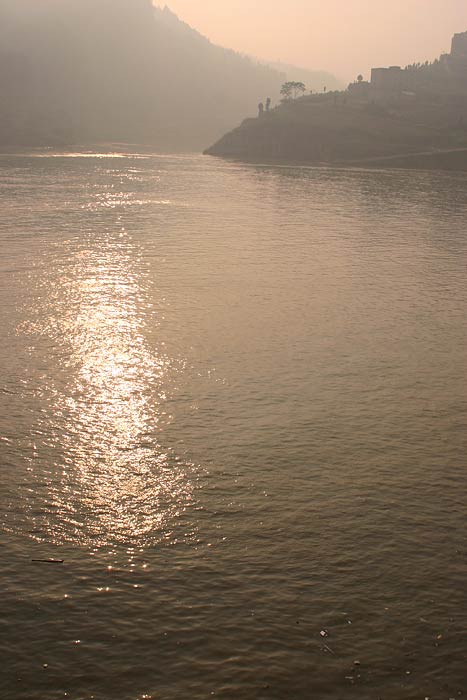 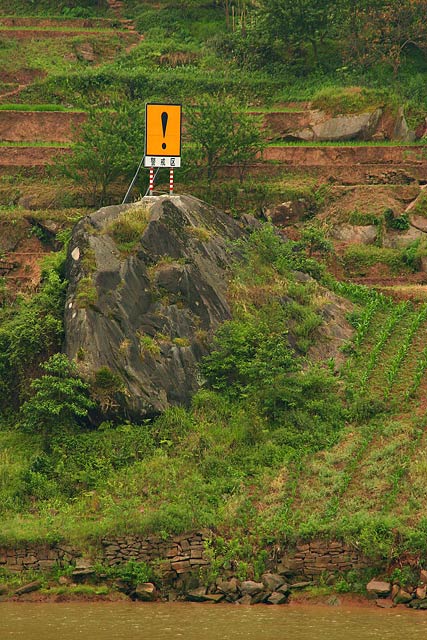
 Yangtze River textures.
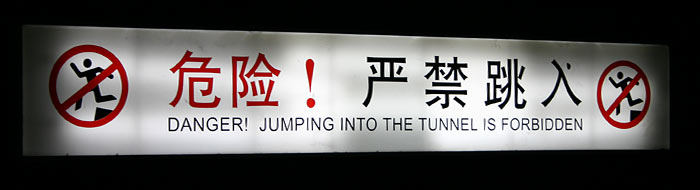  The vast majority of Shanghai residents obey the subway tunnel signs. Working With the Canon Digital Rebel EOS 300D Kiss Digital Camera
I have to say that this Sigma lens has turned out to be a genuine winner. It is light, long range (7.14:1) and crisp enough for editorial work. It also exhibits a magical quality that makes it ideal for EOS 300D buyers: The punishment fits the crime. In other words the value match between initial camera purchase price and the value of this lens compared to its purchase price are both extremely high. You won't feel like the lens is wagging the camera, if you catch my drift. The blow to your wallet or credit card is low (under $180 in several Internet stores) and you will be capable of very fine images with it. Since the zoom range overlaps the Canon Kit Lens range, you will be able to shoot slightly wide (45mm equivalent) to long tele (320mm equivalent) images and those cover the greatest range of focal lengths I typically go for. The zoom is fast and positive, Auto Focus operations are solid for the most part (see my note, earlier) and the longer I used it, the better I got at holding it steady. Think you're hot? Try holding a 320mm lens during a 1/50 sec exposure ten times. Now see why practice makes perfect? But I digress...
Performing manual custom White Balance adjustments with the Rebel is a pain. You have to shoot an image of something white in the light you wish to measure, open the menu, scroll to Custom WB, select it, scroll to the image that contains the WB you want to compensate for, confirm your choice and scroll to the Custom WB icon before taking a shot. That's neither easy nor friendly, and if you have read my comments on the lack of camera interface ergonomics, you might find that I give low marks for this sort of obstructive option selection procedure. One can conceive of a camera that is pointed at a white subject while a special WB button is pressed, this causing a non-recorded exposure that sets up the Preset WB and switches on the Custom WB register(s). Nope, that would be too darn simple, direct, ergonomic and easy. Never mind that this is the exact way you do manual white balance functions with a $125,000 HDTV studio camera... 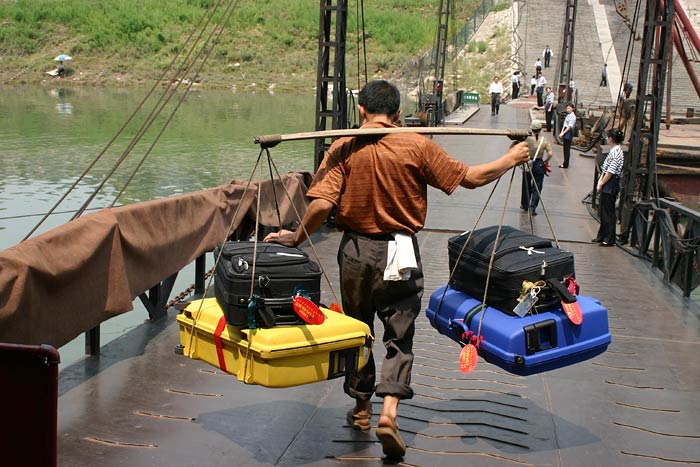 No emotional baggage here. But all the other functions within the Digital Rebel seem to be quite well thought out, so my grumble over this feature is minor. Accessing all other WB settings is super swift and the need for Manual WB is not as great in still image gathering as it is in movie production. 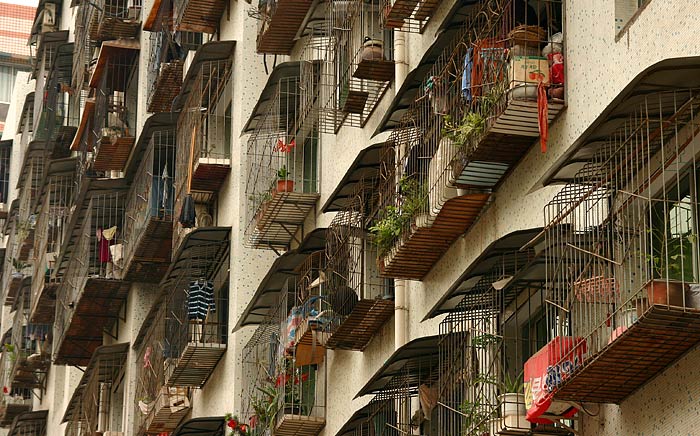 Wan Zhou, a small city of 1.6 million people and 8.2 million photographic situations showed us that the ergonomics of dSLR image gathering are well implemented in the Canon 300D, here shooting through the Sigma 28-200mm f/3.5-5.6 Hyperzoom lens. From viewfinder to final image, the Canon 300D is a diamond with very few flaws. It was always there for me when I needed it to deliver and the images it collected were as good as my eye can orchestrate through any camera. Its simplified menu system and dedicated controls go far in assuring that photography is enhanced while fiddling with the camera, or waiting for it to achieve some function was minimized. As a price to performance combination it seems that the Kiss Digital is the Kiss Of Life.
All rights reserved. Do not reprint. Do not link to images. Reprinting except for newsworthy mention and brief quotes are by permission only |
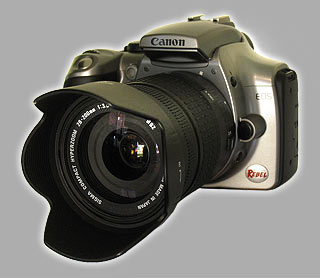 The Least-Expensive dSLR
 The EOS Digital Rebel exposes images with
the same 6.3-megapixel image sensor found in the more advanced
Canon 10D camera.
The EOS Digital Rebel exposes images with
the same 6.3-megapixel image sensor found in the more advanced
Canon 10D camera.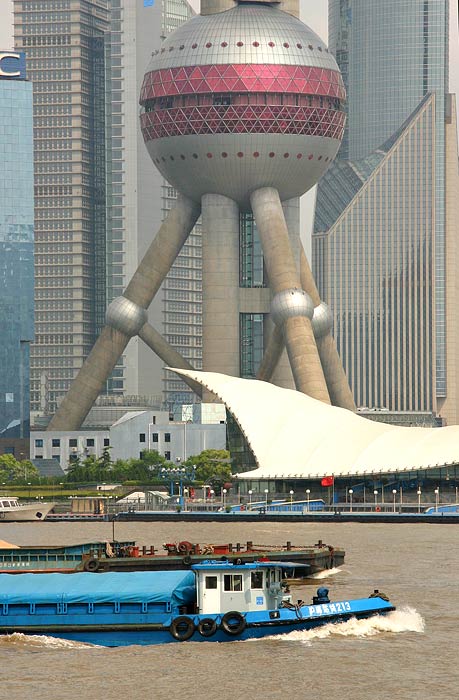 After taking off the Olympus E-1 and picking up
the Canon Digital Rebel / EOS 300D / Kiss Digital (take your
pick) the first impression is, "Why, it's so light! Especially
for a camera that lives under three completely different names!"
even when fitted with the Sigma 28-200mm f/3.5-5.6 Aspherical
Hyperzoom Macro Internal Focus lens (I see that Canon isn't the
only company that likes to over-name things). Lightness around
the neck or shoulder is a definite Good Thing.
After taking off the Olympus E-1 and picking up
the Canon Digital Rebel / EOS 300D / Kiss Digital (take your
pick) the first impression is, "Why, it's so light! Especially
for a camera that lives under three completely different names!"
even when fitted with the Sigma 28-200mm f/3.5-5.6 Aspherical
Hyperzoom Macro Internal Focus lens (I see that Canon isn't the
only company that likes to over-name things). Lightness around
the neck or shoulder is a definite Good Thing. My Canon 50mm f/1.8 fixed focal length
lens operates as would an f/1.8 80mm lens on a full-frame camera.
That's an ideal focal length for portraits and the bokeh (look
of the blur behind sharp focus) is good. That said, I must admit
that I hardly ever used it. For situations that needed extra
light, bracing the camera at a wider angle usually did the trick.
What would really feel useful to me is a 20mm f/1.2 with good
digital MTF and low cost, but that's just a dream.
My Canon 50mm f/1.8 fixed focal length
lens operates as would an f/1.8 80mm lens on a full-frame camera.
That's an ideal focal length for portraits and the bokeh (look
of the blur behind sharp focus) is good. That said, I must admit
that I hardly ever used it. For situations that needed extra
light, bracing the camera at a wider angle usually did the trick.
What would really feel useful to me is a 20mm f/1.2 with good
digital MTF and low cost, but that's just a dream. With the 18-55mm Kit Lens, 28mm (equivalent)
wide angle through 88mm (equivalent) telephoto shots are covered,
so swapping lenses becomes less frequent due to the overlapping
range between the two zooms. That proved handier with the Canon
DR/EOS/300D/KD than working with the E-1, but mid way through
the trip a blob of dust showed up on the image sensor. If I had
not been prepared with the sensor cleaning kit from
With the 18-55mm Kit Lens, 28mm (equivalent)
wide angle through 88mm (equivalent) telephoto shots are covered,
so swapping lenses becomes less frequent due to the overlapping
range between the two zooms. That proved handier with the Canon
DR/EOS/300D/KD than working with the E-1, but mid way through
the trip a blob of dust showed up on the image sensor. If I had
not been prepared with the sensor cleaning kit from 
 Get
the eBooks
Get
the eBooks