Books have been with us for thousands of years. What's the deal with e?
 In the abstract, paper books are a means to record and preserve information so it can be transferred to another human being without the author having to stand there and tell them verbally what's up.
Because books are physical, their data doesn't move around. If the writing says six cows--well, six cows it is. Unlike a web page that is constantly changing.
eBooks emulate books in a different way. They preserve the data, so six cows it is. But they offer interactive features that paper can't deliver: Movies, rollover images, live links and more.
Books of either type move at the speed of you. You get to absorb the ideas in print at your leisure, as fast as it makes sense to you. Unlike movies, time-based tutorial media or, especially, television commercials, you can spend as much--or as little--time as you like with each page.
Before 2000 there were not many eBooks in the world. We made the first one for digital photography and have been advancing the eBook state of the art ever since.
Now there are zillions of publications that call themselves eBooks or e-books or i-books or other variants (most of them little more than text), but what are the benefits of this new reader-paced information delivery system? And what are its drawbacks? And how does it stack up to paper books as an information delivery system?
Here are a number of points culled from the Wikipedia page on eBooks, which they call "E-books".
All of the features mentioned are inherent to our DSLR-series eBooks.
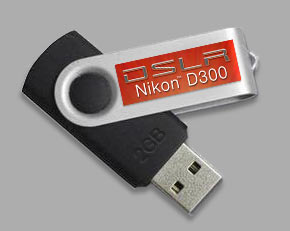
0.125 lb. =
= 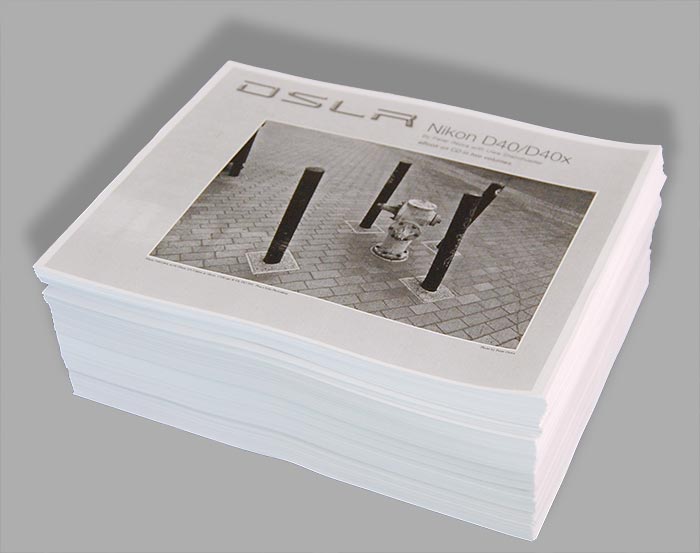 10.2 lbs.
Our latest title, the DSLR Nikon D300 eBook weighs more—printed out—than the world's heaviest laptop.
Comparison with printed books:
 eBook
eBook
Advantages (.pdf files)
From the user's point of view:
• Text may be searched and a list of matches can be generated.
• As data, they take up only computer hard-disk, CD disk space or a key's space as a USB Flash Drive.
• Many can be archived on one hard drive.
• Physically smaller than equivalent printed book.
• Because they require a computer screen, they may be read in the dark or shaded light.
• Selected text may be spoken aloud with available text-to-speech utilities.
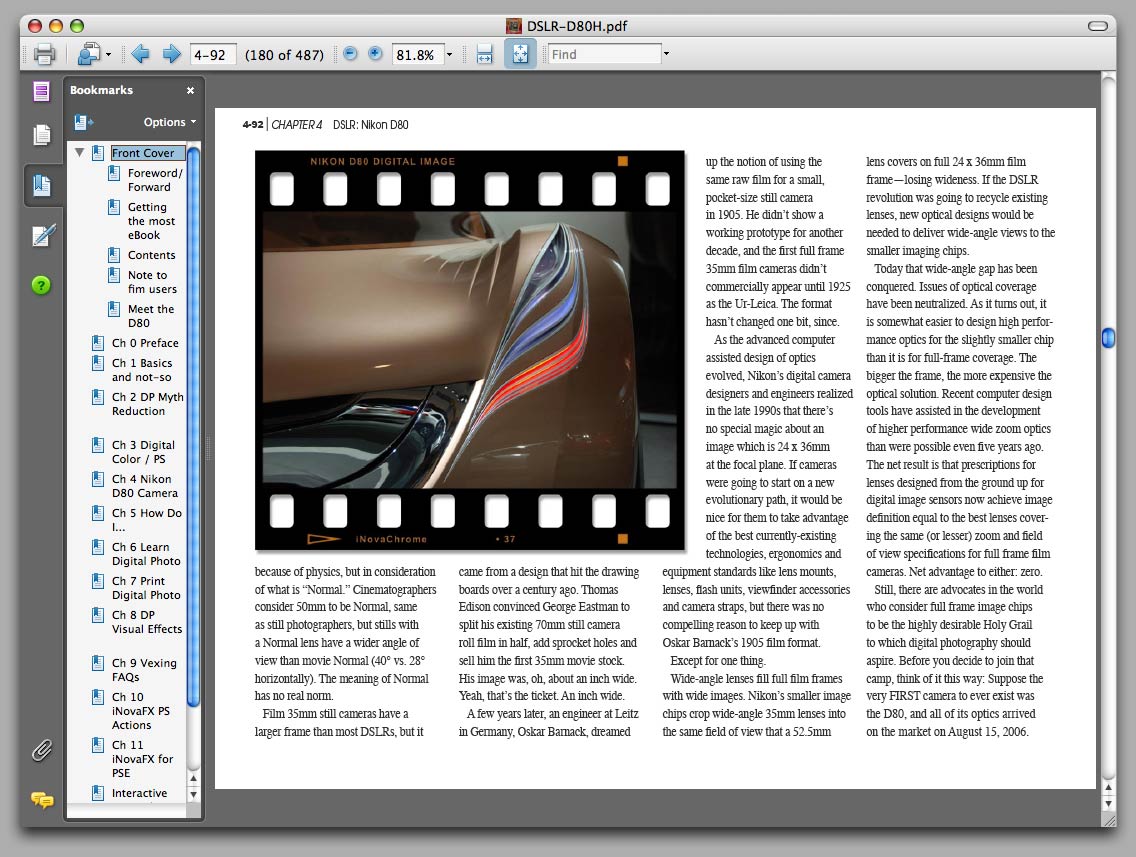
 • Browsing for a page is assisted by interactive thumbnail images. If the eBook is prepared to contain graphically unique-looking pages, visual searching is fast, intuitive and engages your subconscious visual memory.
• eBook pages may be scaled to an appropriate reading size and inspected more closely, at will.
• Every page has an interactive "Bookmark" index available.
• Does not need the original CD/Thumb Drive (may be stored on computer hard drive).
• Once copied, the original is safe from damage, loss.
• Title may be much more elaborate than a printed book with full color throughout, images on every page, unlimited page count and interactive features.
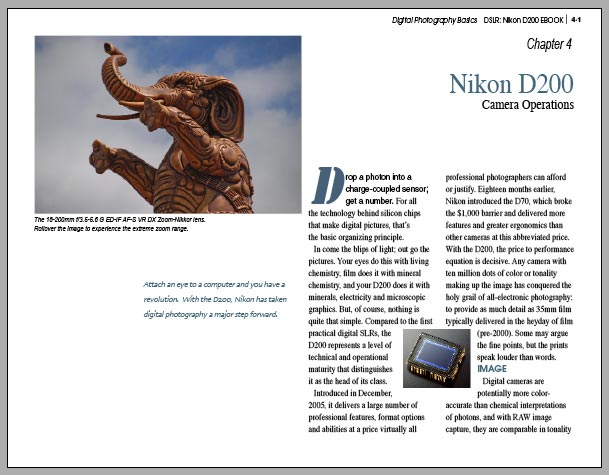 • May be produced without the editorial constraints common in large publishing houses allowing greater editorial freedom and experimentation.
• Reproduction is lower in cost, allowing full color on every page and no limit on page count.
• Embedded images may be interactive via cursor rollovers, mouse clicks, double clicks, etc. (try this with the sample on the right)
• Interactive features can roll embedded animations and movie clips.
• Image quality can exceed printed media with high-density pictures that exceed normal viewing resolution.
• High-density images may be enlarged on screen right up to the limit of pixel density. (DSLR titles enlarge up to 400%, equivalent to holding a printed page four inches from one’s nose.)
• Format allows and encourages cross references within the text that click-jump to other pages.
• Index and Table Of Contents entries may be completely click-interactive.
• Hyperlinks may be embedded, allowing instant Internet connection to printed keywords or URLs.
 • Ecological. Paper and tree use is dramatically less. (CD disk uses very few grams of oil for the plastic and USB Flash Drives have similar low carbon footprint.)
• Requires less ink (packaging and label only plus included booklets).
• Storage space can be as physically small as a CD or USB Flash Drive.
• As data, does not wear out.
• Pages can’t be written on by vandals or toddlers.
• eBook may be expanded by links to associated web pages.
• CD/Thumb Drive can include other sorts of computer files including:
• Software of demonstration or trial computer programs.
• Image files pertinent to tutorials in the text.
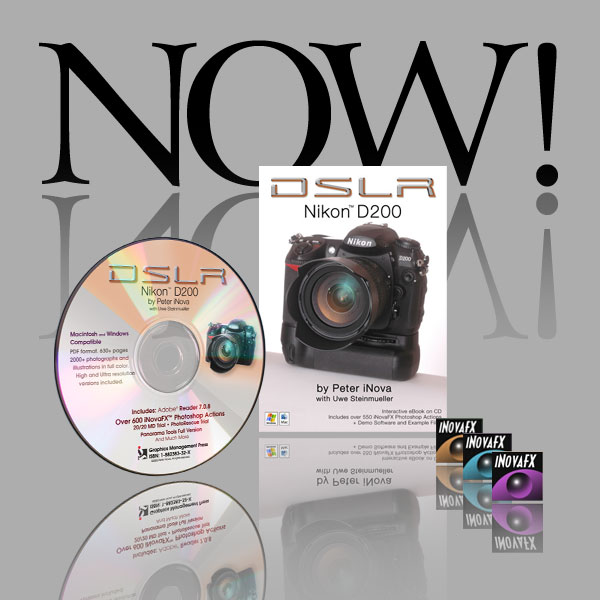
• Custom software files pertinent to concepts in the text (iNovaFX Photoshop Actions, Curves files, etc.).
• Printable files of peripheral use to the reader (Model Release forms, in-camera color filter graphics, grayscale and color charts).
From the publisher/author's point of view:
• Communication isn't limited to static text and images.
• Easier to inventory and distribute.
• Invisible piracy tracking data can be embedded in the file.
• Mailing and physical distribution costs are lower.
Disadvantages
From the user's point of view:
• Original CD must be handled carefully. (USB Drives are more robust.)
• Some do not allow printing (all DSLR-series titles are printable by reader).
• Some do not allow selected text translation (DSLR-series eBooks are not restricted).
• Printing out pages uses reader’s paper and toner or ink (DSLR-series pages that serve well as printed pages are literally prepared to be printed, clipped and taken with you into the world).
• Requires computer for reading.
• Viewing time can be limited by battery power.
• Some may perceive the price to be too high. (As in most media, you get what you pay for.)
• Digital copyright laws do not automatically confer resale permission on buyers. (DSLR-series eBooks may be freely re-sold when we are informed, to avoid the appearance of piracy distribution.)
• People who prefer paper may not appreciate the other indispensable features on balance.
From the publisher/author's point of view:
• Unauthorized copies may be pirated. (Lawyers are standing by.)
 Print book
Advantages
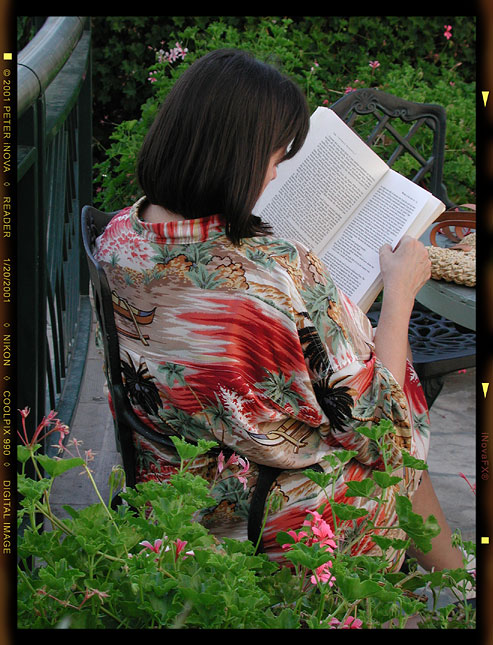
• Physically sturdy. Some have lasted centuries.
• Can survive partial damage and still be read.
• Does not need special viewing device or power.
• May retain collectors value, especially if signed.
• Most printed books come from publishers with deeper pockets than small, independent publishing sources. More advertising or promotional resources may benefit sales.
• Digital copyright laws don’t apply. Books may be sold second-hand easily.
• You can write notes on the pages.
Disadvantages
From the user's point of view:
• Price may make specialty titles difficult to stock and find in stores.
• Can’t be viewed in the rain. (Panasonic ToughBook laptops read eBooks in all weather.)
• Books are very hard to copy.
• Light must be present in abundance for reading.
• Paper books have size and weight that limit portability, storage shelf space and long-term storage environmental conditions.
From the user's and author's point of view:
• Reprints are triggered by mass demand and cannot serve small, targeted audiences of readers.
From an economic point of view:
• Physical storage space limits distribution options and may make titles rare and/or hard to find.
From an environmental point of view:
• Paper eats trees. Then whatever isn’t recycled fills garbage dumps.
From an author point of view:
• At the end of the title’s peak cycle of sales, remaining copies are purposely damaged and sold without royalty accrual.
• Production process is long. Information goes out of date before publishing.
• Correcting errata is expensive, time consuming and often never addressed.
Other:
• Mono-media: Ink on paper. Static. Is not appropriate to works that benefit from interactive images, animations or movie clips. Pop-up books excepted. Somewhat.
• Cannot be interactively cross-linked or hyper-linked to the Internet.
• Physical production constraints involve volumes of paper, multiple passes through a printing press to produce color, trimming, binding and physical quality control over a primarily mechanical process.
Paper books can be read in the loo. If that's your Big Criteria, then we refer you to the MacBook Air or the Apple iPad. Son of Gun: eBooks follow you wherever your need mood takes you.
Seriously, it's the twenty first century. Books are falling into the computer along with the typewriter, telephone, TV set, edit bay, mailbox and your digital camera.
If you haven't experienced a truly advanced eBook, you've missed out.
eBooks are getting more ...um... digital ink these days in the popular press, tech gadget review pages and public consciousness. One of the big reasons is due to Amazon's Kindle and Kindle 2, both eBook readers that have limited capabilities, but great portability.
And we're not the only ones who have noticed this. Apple has thrown their full corporate weight behind the Apple iPad, a 1.5 lb (0.65 kg) eBook reading device that beats the snot out of Kindles and Kindle-kind. Full color, 10 hours of continuous display, wireless, movies, email, Internet, interactive...
While our eBook titles require a laptop, netbook, desk computer or iPad to provide all the interactive, color, animation and movie features they contain, the movement of eBook distribution is toward these features, and every new reader gets closer.
All the DigitalSecrets.Net eBooks are ahead of the Kindle Curve but are not compatible with it. Of course, Amazon wanted to establish a base of readers for its own proprietary distribution, and that's just smart for them, but does not give the world the universal access to digital eBooks that eventually will become commonplace.
Our eBooks are WAAAAAYYYY ahead of the eBook readers prior to Apple's iPad, but they have always been just right for reading on your computer, laptop or desktop.
Here are some interesting further reading links:
ComputerWorld: Mike Elgan
Macmillan goes iPad
eBook WAR!
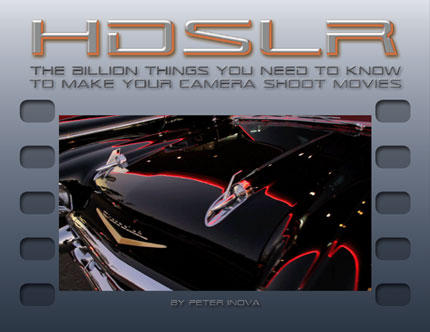
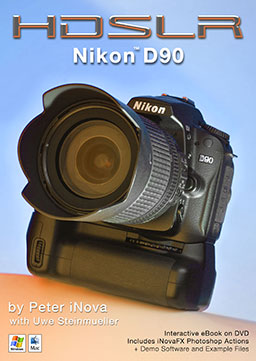
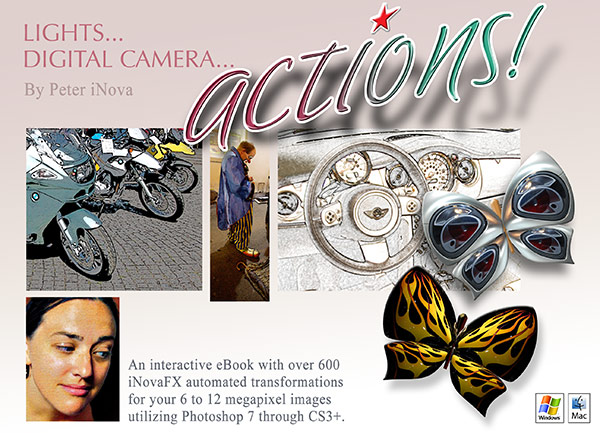
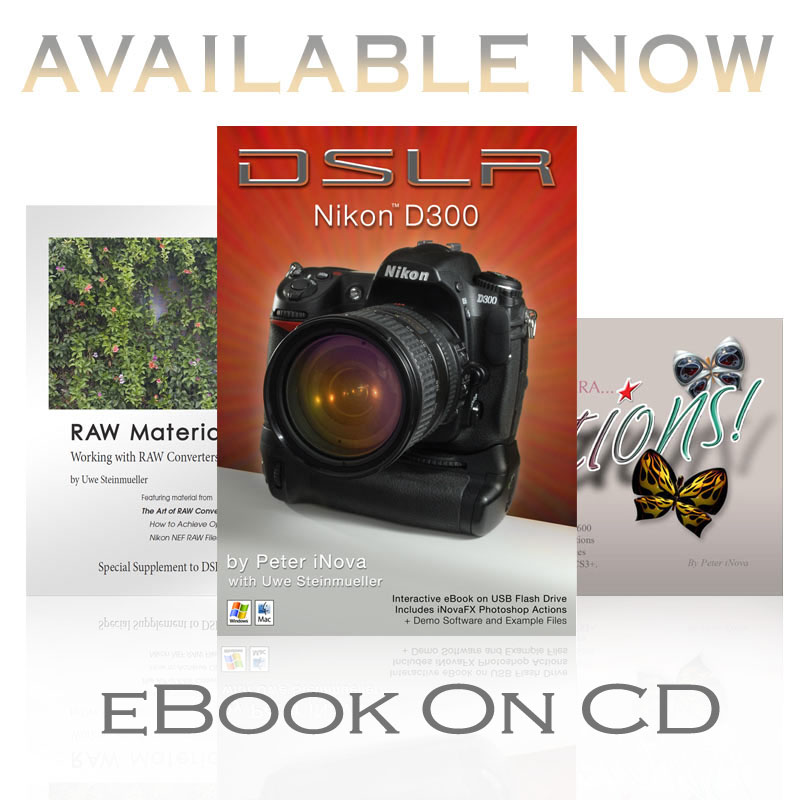
Get The eBook your camera wants.
Versions are available for many Nikons up to the D90/D300s and now HDSLR for all DSLRs with movie mode
Special iNovaFX Photoshop Actions are now available for all 6MP to 18MP cameras with Lights...Digital Camera... ACTIONS! eBook on CD or DVD.
Click on any eBook for the full list.
